

引言
自20世纪中叶以来,青铜病的腐蚀机制逐步为学界所关注并得到系统研究。Gettens[1]、Organ[3]提出氯离子在青铜病腐蚀过程中起核心作用,并建立了以氯化亚铜(CuCl)为中心的经典自催化腐蚀循环理论,这一模型至今仍是青铜病研究的重要理论基础。随着研究的深入,学者们逐渐认识到该腐蚀过程受到微观结构、电化学环境和材料成分等多重因素的综合作用影响。1970—1980年代,更多学者关注并开展了针对青铜病的研究[4-5,7-9]。Lucey[4]、MacLeod[5]等学者进一步提出了膜电池理论和电化学闭塞电池模型,指出点蚀坑内部的局部缺氧环境与富Cl⁻环境共同形成“闭塞电池”,是驱动CuCl水解和腐蚀产物体积膨胀的关键。此外,环境湿度作为最关键的外在条件之一,其对氯化物的活化与水解具有决定性影响[6]。1990年代至21世纪初期,青铜病机理研究从理论模型向实验验证转变,我国学者通过显微分析、电化学测试等方法在腐蚀动力学、局部微环境演化及反应路径量化等方面开展了大量研究,推动了青铜病研究从定性认识向定量阐释的发展[10-25]。


本文在前人工作基础上,结合近年来的最新进展,从腐蚀机制演化路径出发对青铜病的研究进展进行综述。文章将分阶段梳理青铜病腐蚀机理模型的提出和演进过程,阐明各阶段研究的特征及其对青铜病机理认识的提升。尤其关注新兴原位无损检测技术在青铜病腐蚀机理研究中的应用及在其带来的新突破。本文还将总结环境湿度、合金元素对青铜病发展的影响规律,重点关注青铜病发生的临界湿度阈值的研究。
1 青铜病发生机制研究阶段性特征
1.1 CuCl自催化腐蚀循环理论的提出
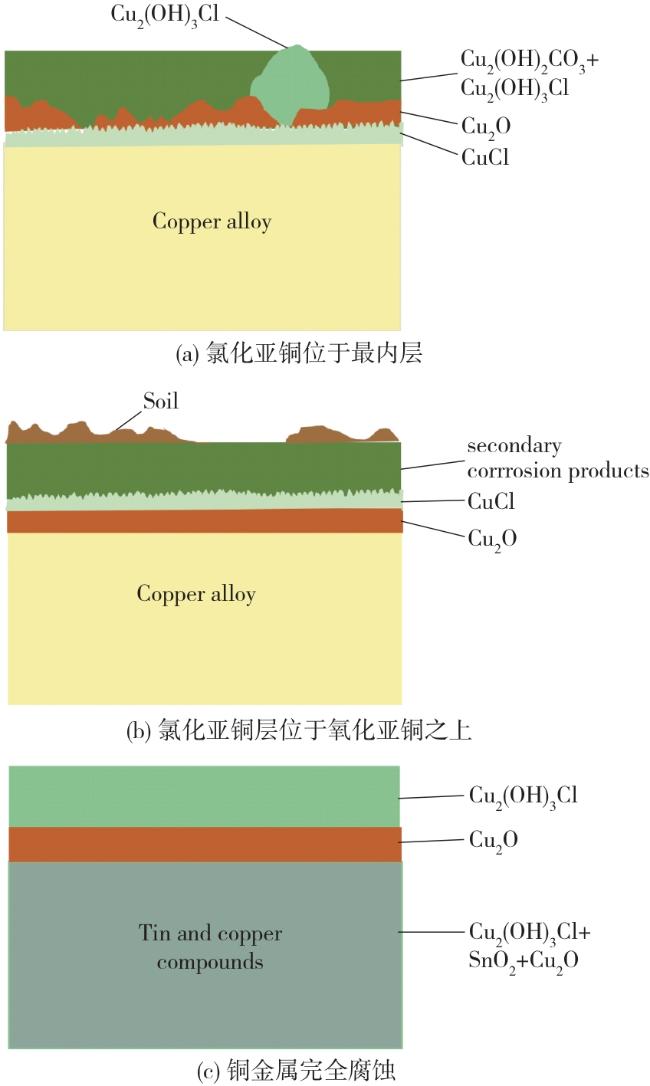
20世纪中期,Gettens[1]和 Organ[2-3]均明确指出CuCl在青铜病中的关键作用。作者通过对青铜锈层的显微观察和化学分析,指出在金属与铜锈之间存在一层潜藏的CuCl层,它在干燥条件下可以长期稳定存在,但一旦暴露于潮湿空气,便会发生一系列不可逆的腐蚀反应。此外,还指出锈层由内向外依次为灰白色蜡状CuCl层,红棕色氧化亚铜(Cu₂O)层和绿色碱式氯化铜(Cu₂(OH)₃Cl)层(图1 (a))。Gettens[1]提出了相对复杂的多步骤化学反应路径,涉及 CuCl₂ 和 Cu(OH)₂ 等中间产物。相比之下,Organ简化了反应步骤,提出了CuCl→Cu₂O→Cu₂(OH)₃Cl的自催化腐蚀路径,即金属铜在氯离子存在下生成CuCl,遇水发生水解生成Cu₂O并释放出盐酸(HCl),随后在氧气参与下转化为Cu₂(OH)₃Cl,产生的HCl侵蚀裸露铜金属,再次生成CuCl。周而复始,构成自催化腐蚀循环,导致青铜文物持续劣化。Organ[3]指出了青铜病腐蚀的几个重要特征:一是潜伏性,即CuCl可在干燥条件下长期潜伏而不发生腐蚀;二是不可逆性,即一旦引发便很难自行停止,金属基体损失不可逆转;三是“传染性”,即氯化物可向周围金属扩散和传播,影响周围其他青铜文物而引发腐蚀。该阶段提出的腐蚀路径可视为“化学循环”,强调CuCl的生成与水解在自催化过程中的关键作用。这一认识基本确立了青铜病腐蚀机制框架,成为后续机理研究的理论基础。
1.2 点蚀和闭塞腐蚀模型的建立
进入1970—1980年代,关于青铜病机理的研究进一步深入,学者们认为青铜病是一种局部电化学过程,提出了“点腐蚀模型”。该模型的核心思想是:在氯离子的作用下金属表面钝化膜在局部缺陷处失效,导致该区域发生局部溶解并形成腐蚀坑,坑内溶液逐渐酸化并富集氯离子,进一步促进金属的持续溶解。该过程具有自催化特征,从而造成蚀坑不断扩展。
Lucey[4]和MacLeod[5]指出,青铜铸造过程中的微缩孔和偏析等缺陷往往是点蚀易发部位。这些缺陷为水汽和Cl⁻提供了藏身之处,形成局部富氯环境,文物出土后在这些缺陷处首先出现粉状锈坑蚀。Lucey进一步提出了膜电池机理以解释点腐蚀发生过程,即Cu2O层作为导电而多孔的隔膜充当双极电极,内表面为阳极,外表面为阴极;孔隙内部Cu⁺被氧化为Cu²⁺,使局部Cu²⁺浓度升高,打破了Cu-Cu+-Cu2+间的平衡,迫使金属Cu持续溶解以维持平衡;Cu²⁺在外部沉淀或扩散回膜内,再参与还原循环;坑外O₂被还原为OH⁻。此模型消解了传统的要在金属表面隔离阳、阴极区的假设,强调腐蚀产物膜本身的电化学双极效应。MacLeod[5]从热力学和电化学角度解释了点腐蚀过程。他指出,在标准条件下,CuCl的水解在热力学上并不自发(ΔG 0>0),仅靠化学驱动难以进行,须有额外的电化学“推动力”才能使腐蚀循环进行,例如合金中活泼金属元素(如Zn)的存在造成原电池效应促进Cu的氧化溶解等。作者强调了铜合金成分和微观组织对腐蚀的影响,不同合金元素会改变局部电极电位,从而影响CuCl转化反应的进行。Scott[6]综述了前人工作和既往理论,从化学与环境角度深入阐释了青铜病机制。他结合Cu-Cl-H₂O体系Pourbaix图,明确了Cu、CuCl和Cu2O的腐蚀发生条件(pH=3.5,+270 mV (SHE))。作者提出铜的络合物(CuCl₂、CuCl 、CuCl )在反应过程中起到重要作用,强调了环境条件对青铜病发生过程的影响,并基于实验确定了CuCl发生转化的临界湿度条件(RH约为40%)。这一阈值至今仍是青铜文物预防性保护的重要依据。
该阶段青铜病的化学反应路径已基本确定,总结如下。
(1)CuCl的形成
在含Cl⁻、有氧环境中,高浓度Cl⁻可在Cu₂O膜的缺陷、晶界和微裂纹处优先吸附并形成CuCl₂⁻络合物,使得局部pH下降,导致Cu₂O膜孔蚀或点蚀破裂,Cu金属迅速与Cl⁻反应生成CuCl,开启局部腐蚀。
4Cu + O2 + 4Cl- + 2H2O→4CuCl + 4OH-
(2)CuCl的水解
暴露于水或高湿环境时,CuCl会发生水解,生成Cu₂O并释放出H⁺和Cl⁻。
2CuCl + H2O→Cu2O + 2H+ + 2Cl-
(3)CuCl的再生
生成的HCl对裸露铜产生酸蚀,重新生成CuCl并释放H₂。
2Cu +2HCl→2CuCl + H2
该反应使Cl⁻不断再生、局部pH持续偏低,使自催化循环闭合,驱动青铜病持续发展。
(4)Cu₂(OH)₃Cl的产生
在潮湿含氧条件下,CuCl与O₂、H₂O反应,生成浅绿色、粉状的Cu2(OH)3Cl。反应伴随体积膨胀,是青铜病典型粉状锈蚀产物的来源。
4CuCl + O2 + 4H2O→2Cu2(OH)3Cl + 2HCl
本阶段研究将青铜病的认识从单一化学反应路径拓展为局部电化学腐蚀过程,成为后续研究广泛引用的反应路径和腐蚀模型。该阶段为青铜病腐蚀机制研究的理论成型期。
1.3 模型的实证与理论拓展
20世纪90年代至21世纪伊始,随着分析技术进步,青铜病机理模型逐步在实验上得到验证。该阶段学者们在青铜病的基本腐蚀过程方面已达成了共识 。中国学者在青铜病的腐蚀动力学方面进行了深入研究。范崇正、王昌燧等[11-14,16]通过模拟实验和电化学测试提出了粉状锈自催化机制和小孔腐蚀理论。范崇正等[12,14,17]采用红外反射和光声光谱原位监测CuCl由Cu2O中间产物转化为Cu₂(OH)₃Cl的动力学过程,提出了该转化反应的具体路径和速率方程。通过微电极测量,作者揭示了腐蚀坑内Cl⁻富集与酸度增加的过程,验证了早期学者提出的点腐蚀模型中HCl再生侵蚀金属的现象。作者还指出粉状锈生成的初始阶段为胶体分散系,在湿热酸性条件下快速传播,在空气中具有传染性,用实验证实了Organ[3]的观点。王昌燧等[16]通过模拟实验和文物本体分析进一步补充了晶体结构与合金成分对青铜病生成的影响,利用X射线衍射分析(XRD)与透射电子显微镜(TEM)发现,粉状锈多起源于合金晶界与晶面棱角处的点蚀,对应CuCl初生沉积位点。祝鸿范等[18,20]设计了一种模拟闭塞电池装置,真实再现了青铜孔穴环境,测量了腐蚀过程中孔内外pH、Cl⁻浓度和电位变化,定量验证了MacLeod[5]提出的闭塞电池理论中闭塞环境的形成及维持机制。中国学者的研究从动力学方面实证了早期西方学者提出的理论,并提供了重要的数据支持。Wang等[40]通过循环伏安等技术模拟了青铜在含氯溶液中的阳极溶解过程,发现铜在缺氧或弱酸性闭塞环境中主要氧化生成CuCl,而在恢复中性及通氧条件下又可还原出金属铜。这一结果与闭塞孔内CuCl沉积/还原的电化学循环模型相吻合。
该阶段研究在多方面验证了早期西方学者提出的化学与电化学腐蚀模型,并从动力学、微环境形成机制等方面予以拓展与量化,青铜病腐蚀研究从理论模型开始走向实证阶段。
1.4 内部探测新技术与腐蚀机理新进展
进入21世纪,借助新兴的分析技术手段,青铜病机制研究取得了新的进展。Grayburn等[26]利用同步辐射X射线衍射(SR-XRD)实时原位追踪CuCl的水解转化过程,首次直接观察到了CuCl向Cu2O转变的整个进程。在模拟埋藏环境(低氧、高湿)的实验中,作者发现CuCl层在纯水中约5 h内即完全转化为Cu₂O。这一实验直观证实了早期理论中CuCl→Cu₂O水解反应的发生,并量化了该反应所需的条件和速率。Bozzini等[27]利用同步辐射扫描光电子显微谱学(SPEM)对青铜病相关腐蚀产物进行空间分辨的化学态与成分分析,揭示了铜-锡-氯腐蚀产物的微观分布和化学态演变,验证了CuCl—Cu₂O—Cu₂(OH)₃Cl 循环机理中HCl对Sn腐蚀的协同作用,以及合金微结构对腐蚀分布的影响,深化了对青铜病中Cu与Sn腐蚀协同机制的理解。Thunberg等[29]运用中子活化分析(PGAA)无损测定了39枚罗马铜钱币中的整体氯含量,并通过中子照相定位氯在钱币剖面中的分布,系统评估了不同氯化物含量对青铜病爆发的影响。作者将含氯化物的铜币放入高湿环境(RH 80%~90%)长达数月后,未发现新的青铜病腐蚀现象,因此强调在青铜文物中检测到氯化物并不能说明青铜病必定发生。龚钰轩等[30]、Wang等[40]利用X射线显微CT断层扫描技术(micro⁃CT)实时追踪青铜病模拟样品的腐蚀演变和迁移过程,还通过模拟粉状锈剥落和飘移的实验实证了青铜病具有传染性。
该阶段的主要特点是采用原位无损内部探测技术对青铜病的发展过程进行追踪,捕获瞬时的腐蚀状态,连续监测腐蚀变化,为青铜病的机理研究提供了新的视角。
2 环境湿度对青铜病的影响及临界湿度阈值
为了遏制青铜病的发展,控制环境相对湿度被认为是最关键的预防性保护措施之一[6,29,41-45]。然而,目前关于安全湿度阈值的具体界定尚不统一,文献中所提临界值范围存在显著差异,各博物馆与研究机构在干燥保存策略上的实践标准亦不尽相同。为厘清湿度对青铜病激发的作用机制,近30年来国内外学者开展了大量模拟腐蚀实验,研究不同RH条件下的腐蚀行为演化过程。已有研究表明,在某一RH阈值以下,受氯污染的青铜可以基本保持惰性,而一旦超过该阈值,腐蚀将迅速加剧。即使青铜文物已完全矿化,RH仍有可能对其造成影响。Ahmed等[46]报道了一例完全矿化的古代铜碗在出土后因毛细作用吸水而重新出现青铜病的案例。该铜器虽已矿化完全,但锈层中残留了大量的CuCl和可溶性氯盐,仍具有自催化腐蚀能力,可转变为Cu2(OH)3Cl造成体积膨胀和粉化。
研究普遍认为,青铜病的临界湿度范围处于中等湿度区间,但受文物本体含氯量、锈层结构、污染环境和表面微环境等因素影响,实际临界值仍存在一定波动。以下将结合已有实验结果,对该临界湿度范围的界定进行总结和讨论。
1)RH约为35%~40%:传统认定的青铜病安全上限
大多文献与保护实践表明,RH约40%是目前最广泛接受的青铜病相对安全湿度上限。Organ[3]通过实验测试了CuCl在不同湿度条件下的稳定性与转化速率,指出当RH降低到35%,CuCl在较长时间内保持稳定,几乎不发生转化。作者据此将RH 35%视为阻止青铜病发生的临界安全阈值。随后,Bradley[42]的研究也得出了相同的结论,并在实际青铜文物保护工作中得到了验证。Scott[6]通过对模拟样品(CuCl压片、CuCl粉末及铜粉混合物)进行为期两年的实验发现,在RH为42%~46%条件下,CuCl不会发生水解。Rimmer等[43]、Thunberg等[29]提出了类似的观点,即如果保存环境的RH保持在约40%以下,受氯污染的青铜文物基本处于惰性状态。Thickett[47]通过监测密闭舱中模拟青铜样品(铜和CuCl混合粉末)在不同RH条件下的氧气浓度变化,研究了青铜病对RH的敏感性,实验结果表明在 RH为28%下观察到金属铜与CuCl的反应,在RH为40%时氧耗速率显著增加。在实践中,文物保护人员通常将RH控制在35%~40%以下来保存不稳定的青铜文物,以确保CuCl长期维持稳定状态[48]。
2)RH约为50%~60%:青铜病发生“警戒区”
当相对湿度处于50%~60%时,腐蚀开始加速,青铜的腐蚀风险显著升高,常被称为“湿度警戒区”。Organ[3]指出CuCl在RH为58%条件下约需24 h即发生转化。Scott[6]指出,当RH超过约55%时,腐蚀反应“变得非常剧烈”,铜的氯化物开始快速转化为体积膨胀的碱式氯化铜,并据此建议,含活性CuCl的青铜文物在博物馆保存中应避免长期暴露于RH大于55%的环境中。加拿大文物保护研究所(CCI)在其保护指南[44]中也指出,当RH高于55%时,青铜病开始活跃,文物表面可见绿色粉状腐蚀产物。Papapelekanos[49]利用环境实验箱开展了模拟青铜腐蚀实验,结果表明RH达到63%时才会发生显著腐蚀。有研究将RH 42%~60%视为触发青铜病的“警戒区”[44], 在这一湿度区间内,文物的腐蚀风险因情况而异:若文物本体氯含量较高或表层锈层疏松、透气性强,则更易因湿度升高而进入腐蚀活跃状态;而含氯量较低或锈层致密水分难以渗透的文物,在短期内仍可能保持相对稳定。
3)RH大于70%:青铜病发生高风险区
4)RH阈值的可变性
(1)温度。温度升高可加速腐蚀反应,导致在较低RH下腐蚀仍然活跃。
(2)其他盐分的存在。海盐(NaCl)或空气污染物可吸湿并形成局部微环境,使青铜在较低RH条件下仍可能发生腐蚀。由于氯盐的存在,可致使实际临界RH比理想值更低(约38%左右甚至以下)[44]。
(3)铜锈层的影响。一方面,青铜锈层(如SnO₂层或碱式碳酸铜)可在一定程度上缓冲湿度波动,使其耐受较高的RH;另一方面,锈层中的裂隙、孔洞等可吸收水分,形成局部盐溶液。即使在整体湿度低于临界值的情况下,微孔中的吸附水仍可维持腐蚀,直至水分被消耗完全[6]。
5)波动阈值
综上所述,严格控制RH是防止青铜病引发的腐蚀损坏的关键。即便小幅超出临界湿度,也可能导致腐蚀不可逆地加速发展。因此,保持稳定低湿环境是目前保存患青铜病文物的常见策略。
3 合金成分对青铜病的影响
MacLeod[5]在1980年代时便指出铜合金中的不同元素会影响CuCl的转化。他认为黄铜中锌的存在可降低铜的电化学电位,促进CuCl水解生成Cu₂O;而高锡青铜中锡相的存在可能延缓CuCl水解,导致更多CuCl累积于锈层内。王昌燧等[16]研究了青铜合金成分对青铜病的影响,指出在Sn含量不同的青铜中,10%(质量分数)Sn合金比纯铜更易生成粉状锈,而w(Sn)≥20%时粉状锈生成受抑。Bozzini等[27]利用高分辨SPEM和微区X射线光电子能谱(XPS)研究了锡含量(质量分数约为13%)及其相分布对青铜病进程的影响,指出Cu与Sn的腐蚀相互耦合——CuCl水解产生的HCl也协同加速了δ相的溶解和Sn(OH)Cl、SnO/SnO2的生成,形成了酸化的腐蚀环境并诱发Cu相的腐蚀,因此,高Sn含量合金易在相界处形成活性腐蚀位点。这与文献[16]的研究结果基本一致。Chang等[39]通过长时间海洋大气暴露与加速腐蚀试验,研究了Sn含量分别为4%与6%的青铜在含氯环境下锈层的演化特征,结果表明在富锡青铜表面形成的锈层呈现明显的层状结构——由富Cu₂O致密层和富Cu₂(OH)₃Cl疏松层交替堆积,中间夹杂着SnO₂等薄层。这种铜锈-锡锈交替分层的现象,被解释为由周期性氯沉积和湿润干燥循环所致。锡的存在促进了锈层的分层和剥落,导致含锡青铜相比纯铜在含氯环境中腐蚀更快。该研究与文献[16]研究一致,并从锈蚀形态和锈层结构特征方面深化了对锡元素影响青铜病腐蚀过程的认识。Fan等[51]研究了含氯环境中青铜合金的初始腐蚀行为,比较了有氧与无氧条件下的腐蚀差异,发现在无氧环境中Sn更容易与氯离子反应生成富氯层(如SnCl₂·H₂O),并在后续水解过程中形成SnO₂,最终,锈层呈现出CuCl、Cu(OH)₂、富氯层和SnO₂等腐蚀相的叠加特征。这一分层结构与Chang等[39]观察到的结果高度一致,进一步说明了Sn在锈蚀产物分层与腐蚀加剧中的关键作用。铜合金中Sn元素的存在不仅影响CuCl的反应行为与稳定性,还可能改变锈层的分层结构、腐蚀形貌以及腐蚀路径。
4 结束语
本文系统梳理了自20世纪中叶以来青铜病腐蚀机制的发展脉络,将其划分为4个关键阶段:一是以CuCl为核心的自催化腐蚀循环理论提出阶段,奠定了青铜病研究的基本理论框架;二是点蚀与闭塞腐蚀机制建立阶段,明确了局部微环境和电化学条件在腐蚀过程中的主导作用;三是实验验证与理论拓展阶段,通过模拟实验与电化学测试量化了腐蚀动力学并实证了早期模型;四是原位无损动态检测手段的发展阶段,利用同步辐射、中子成像和micro⁃CT等高分辨手段,对中间产物转化与锈层结构演化进行实时追踪。
文章还系统总结了触发青铜病的环境湿度阈值。RH小于40%时CuCl基本稳定,处于潜伏状态;RH大于55%后腐蚀活性显著增强;RH大于70%则进入失控区。湿度临界值因青铜文物锈层结构和微环境差异等因素存在波动。此外,锡等合金成分对青铜病具有重要作用,不仅影响CuCl的稳定性和腐蚀产物类型,还通过促进锈层分层、加剧相界腐蚀,从而改变病害演化路径。
未来研究应将深部无损探测技术与定量腐蚀动力学模型结合,深入解析CuCl在锈层与金属基体间的迁移、转化与扩散过程,同时构建可量化、可预测的腐蚀风险评估体系。这将有助于深化对青铜病机理的认知,并为青铜文物保护提供更精准的干预策略。